Understanding data types and operators in Java is fundamental for writing efficient and effective programs. These concepts form the backbone of any Java application, enabling developers to store, manipulate, and process data. Whether you’re building simple scripts, Android apps, or enterprise software, mastering data types and operators is essential for both beginners and experienced programmers. This article explores Java’s data types, their uses in daily programming, and the operators that allow you to perform computations and make logical decisions.
What Are Data Types?
In Java, a data type defines the kind of data a variable can hold and how much memory it will occupy. Choosing the correct data type is crucial because it affects the program’s performance, accuracy, and resource utilization.
Java has two primary categories of data types:
- Primitive Data Types
- Reference Data Types
1. Primitive Data Types
Primitive types are the most basic types of data. Java has eight built-in primitive types:
| Type | Size | Description | Example |
|---|---|---|---|
byte | 1 byte | Small integers | byte age = 25; |
short | 2 bytes | Larger integers | short temperature = 300; |
int | 4 bytes | Standard integers | int salary = 50000; |
long | 8 bytes | Very large integers | long population = 7800000000L; |
float | 4 bytes | Decimal numbers (single precision) | float price = 19.99f; |
double | 8 bytes | Decimal numbers (double precision) | double pi = 3.14159; |
char | 2 bytes | Single characters (Unicode) | char grade = 'A'; |
boolean | 1 bit | True/false values | boolean isJavaFun = true; |
Example Usage:
int age = 30;
double salary = 55000.50;
char grade = 'A';
boolean isEmployed = true;

System.out.println("Age: " + age);
System.out.println("Salary: $" + salary);
System.out.println("Grade: " + grade);
System.out.println("Employed: " + isEmployed);
Explanation:
- The
+operator is used here to concatenate strings and variables. - Each variable is declared with a specific type, telling Java what kind of data it can store.
2. Reference Data Types
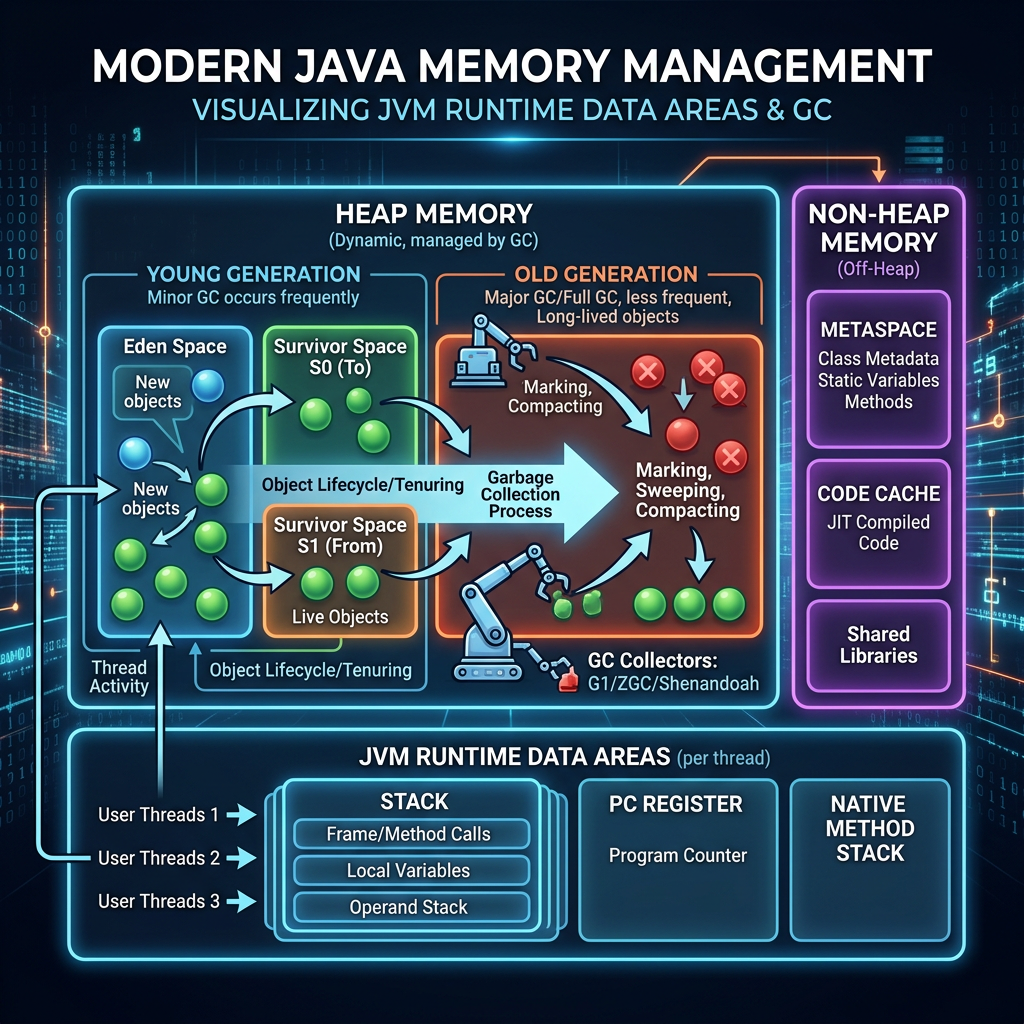
Reference types are used for objects. Unlike primitive types, they do not store the data directly but store a reference (or memory address) to the object in memory. Common reference types include:
- Classes:
String,Scanner,ArrayList - Arrays: Collections of elements of the same type
- Interfaces and Enums
Example:
String name = "John Doe";
int[] numbers = {1, 2, 3, 4, 5};

System.out.println("Name: " + name);
System.out.println("First number: " + numbers[0]);
Explanation:
Stringand arrays are objects in Java.numbers[0]accesses the first element in the array.
Operators in Java
Operators allow you to manipulate data. They are special symbols that perform specific operations on variables and values. Java has several categories of operators:
- Arithmetic Operators
- Comparison Operators
- Logical Operators
- Assignment Operators
- Unary Operators
- Ternary Operator
1. Arithmetic Operators
Used for mathematical operations, including addition, subtraction, multiplication, division, and modulus.
| Operator | Description | Example |
|---|---|---|
+ | Addition | 5 + 3 = 8 |
- | Subtraction | 5 - 3 = 2 |
* | Multiplication | 5 * 3 = 15 |
/ | Division | 5 / 2 = 2 |
% | Modulus (remainder) | 5 % 2 = 1 |
Example:
int a = 10;
int b = 3;

System.out.println("Sum: " + (a + b));
System.out.println("Difference: " + (a - b));
System.out.println("Product: " + (a * b));
System.out.println("Quotient: " + (a / b));
System.out.println("Remainder: " + (a % b));
2. Comparison Operators
Used to compare values. They return a boolean (true or false).
| Operator | Description | Example |
|---|---|---|
== | Equal to | a == b |
!= | Not equal to | a != b |
> | Greater than | a > b |
< | Less than | a < b |
>= | Greater or equal | a >= b |
<= | Less or equal | a <= b |
Example:
int x = 10;
int y = 20;

System.out.println(x == y); // false
System.out.println(x < y);  // true
3. Logical Operators
Used to combine multiple boolean expressions.
| Operator | Description | Example |
|---|---|---|
&& | AND | true && false = false |
| ` | ` | |
! | NOT | !true = false |
Example:
boolean hasID = true;
boolean isAdult = false;

if (hasID && isAdult) {
    System.out.println("Access granted");
} else {
    System.out.println("Access denied");
}
4. Assignment Operators
Used to assign values to variables, often combined with arithmetic operations:
| Operator | Description | Example |
|---|---|---|
= | Assignment | x = 10 |
+= | Add and assign | x += 5 (x = x + 5) |
-= | Subtract and assign | x -= 3 |
*= | Multiply and assign | x *= 2 |
/= | Divide and assign | x /= 2 |
%= | Modulus and assign | x %= 3 |
5. Unary Operators
Used with single operands:
++Increment--Decrement+Positive-Negative
Example:
int count = 5;
count++;
System.out.println(count); // 6
6. Ternary Operator
A shorthand if-else operator:
int age = 20;
String result = (age >= 18) ? "Adult" : "Minor";
System.out.println(result);
Practical Applications in Daily Life
Understanding data types and operators is not just academic—it has real-world applications:
- Finance Applications: Calculating interest rates, tax, and payroll involves arithmetic operations.
- E-commerce: Comparison and logical operators are used to validate user input, manage inventory, and process orders.
- Gaming: Operators are used to calculate scores, levels, and game physics.
- IoT Devices: Sensors use numeric data types and logical operators to make real-time decisions, like adjusting a thermostat.
Career Benefits
Mastering data types and operators in Java sets the stage for:
- Backend Development: Efficient data manipulation is essential for server-side applications.
- Data Analytics: Handling large datasets requires precise data typing.
- Android Development: Mobile apps frequently involve user input, calculations, and conditional logic.
- Problem Solving: Knowing operators helps programmers solve complex algorithmic challenges efficiently.
Conclusion
Java data types and operators are the fundamental tools every programmer needs. Understanding how to declare variables, choose appropriate types, and use operators effectively allows you to write clean, efficient, and error-free code. From daily life applications to professional programming careers, these basics are indispensable. By mastering these core concepts, you lay a solid foundation to explore more advanced topics like object-oriented programming, data structures, and algorithms.


Leave a Reply