In Java development, memory management is often treated as something “handled by the JVM.” While this is technically true, it is also dangerously incomplete. A strong Java engineer does not merely rely on automatic garbage collection—they understand how memory behaves under load, how objects live and die, and how subtle inefficiencies can cascade into system-wide performance degradation.
Java’s design emphasizes safety and abstraction, where memory is managed through the Java Virtual Machine (JVM) using garbage collection mechanisms. However, modern systems—especially microservices, high-throughput APIs, and cloud-native applications—demand a deeper level of awareness.
1. The Illusion of “Automatic” Memory Management
Garbage collection (GC) gives developers the convenience of not manually allocating and freeing memory. But this abstraction creates an illusion: that memory is no longer your concern.
In reality, GC introduces:
- Pause times (stop-the-world events)
- Heap fragmentation
- Allocation pressure under high concurrency
These are not theoretical concerns. In production systems, inefficient memory patterns can result in latency spikes, degraded throughput, or even system crashes.
Understanding GC is not optional—it is part of engineering discipline.
2. Heap Structure and Object Lifecycle
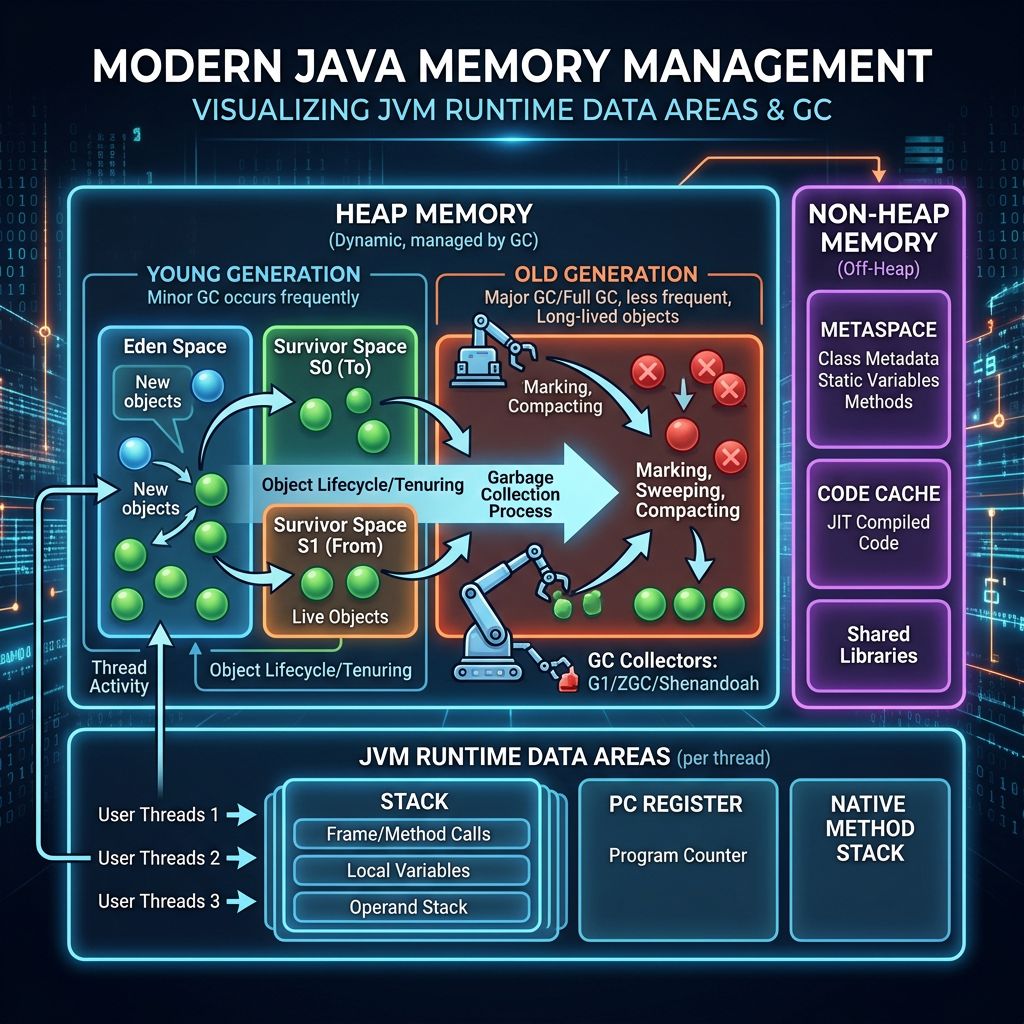
At its core, the JVM divides memory into distinct regions:
- Young Generation (Eden + Survivor spaces)
- Old Generation (Tenured space)
- Metaspace (class metadata)
Most objects die young. This empirical observation shapes how GC algorithms are designed. Short-lived objects are collected quickly in the young generation, while long-lived objects are promoted to the old generation.
However, poor design patterns—such as excessive object creation, large immutable data structures, or unnecessary caching—can disrupt this balance.
Example pitfalls:
- Creating temporary objects in tight loops
- Retaining references unintentionally (memory leaks)
- Using collections without proper size management
These patterns increase GC frequency and reduce system efficiency.
3. Modern Garbage Collectors: Choosing the Right Strategy
Java has evolved significantly in its GC implementations. Today’s developers must choose between multiple collectors, each optimized for different workloads:
- G1 GC: Balanced for latency and throughput
- ZGC: Ultra-low latency, suitable for large heaps
- Shenandoah: Concurrent GC with minimal pause times
The choice is architectural. For example:
- A financial trading system prioritizes low latency
- A batch-processing system prioritizes throughput
- A cloud service balances both under elastic scaling
There is no universally “best” GC—only context-appropriate decisions.
4. Memory Profiling and Observability
Modern Java engineering is inseparable from observability. Memory behaviour must be measured, not assumed.
Key tools include:
- JVisualVM
- Java Flight Recorder (JFR)
- Heap dumps and GC logs
Metrics to monitor:
- Allocation rate
- GC pause time
- Heap usage trends
- Object retention paths
Without these insights, performance tuning becomes guesswork.
5. Designing for Memory Efficiency
Efficient memory usage is not achieved through tuning alone—it is designed into the system.
Best practices include:
- Prefer primitive types where applicable
- Reuse objects in high-frequency paths
- Avoid unnecessary boxing/unboxing
- Use streaming APIs carefully (avoid hidden allocations)
- Apply caching with strict lifecycle control
In large systems, memory efficiency compounds. Small improvements at the object level translate into substantial gains at scale.
Closing Insight
Memory management in Java is not about fighting the JVM—it is about collaborating with it. The JVM provides powerful abstractions, but it rewards developers who understand its internal mechanics.
In modern Java systems, performance is not just about algorithms—it is about how efficiently memory is created, managed, and released.
To master Java is to move beyond “it works” into “it scales.”



Leave a Reply